
Language games with a hand puppet: 10 movement games for nurseries, groups and practices
Ten games in which a hand puppet links words and movement: clapping syllables, rhyme jumps, games with “on” and “under”, and a tongue workout. For nurseries, groups and therapy sessions, with little preparation.
How to play: the ten games
Most of the games need nothing more than one hand puppet and a little space. The puppet sets the tasks, and the children answer with words or movement.
1. Clapping names
To say hello, the hand puppet calls each child by name, and everyone claps out the syllables: Ol-i-ver, A-me-li-a, Sam. The puppet nods along to the beat. Anyone who likes can then greet the puppet and clap out its name.
2. Mampfred says …
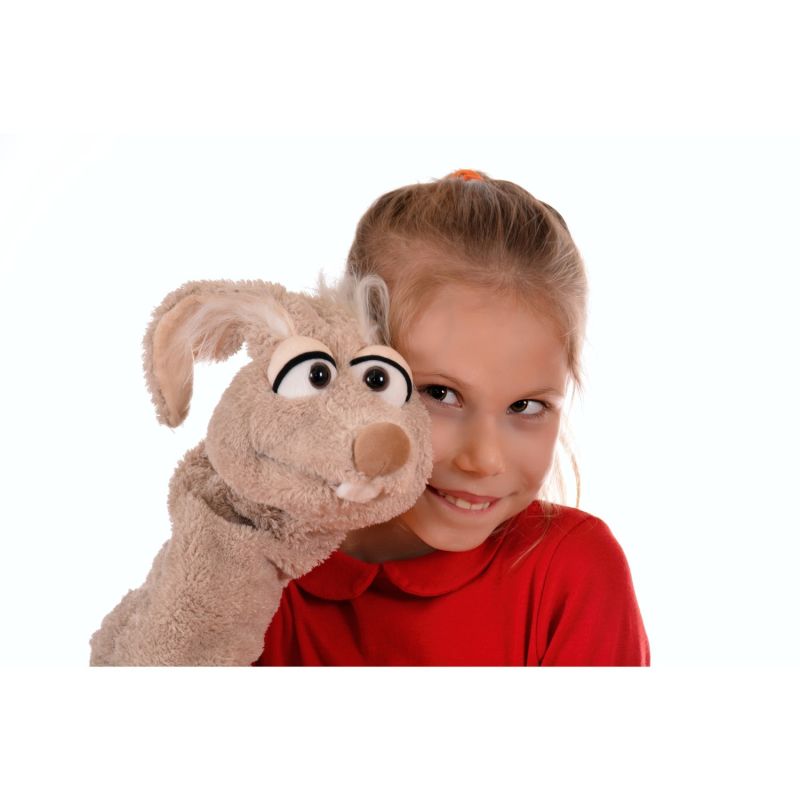
Just like Simon Says, the puppet gives instructions, and the children only obey when it starts with its own name, for example Mampfred the bunny: “Mampfred says: hop on one leg!” With a different puppet, use its name. If it just calls “Sit down!”, everyone should stay standing, and whoever sits down anyway usually sets the whole group laughing.
3. Loud and quiet
When the hand puppet speaks loudly, everyone stretches up tall with their arms in the air. When it whispers, everyone curls up small. As the game goes on, the puppet switches between loud and quiet faster and faster.
4. Where is the hand puppet?
The hand puppet is placed on, under, behind or next to a chair. The children say where the puppet is, then sit or crouch in the same spot by their own chair. Later, a child gets to place the puppet.
5. Guess the animal
The hand puppet makes an animal noise or describes an animal: “It has a long neck and eats leaves from tall trees.” Whoever guesses it moves around the room like the animal, and the others join in.
6. Rhyme jumps
Two words, and the children decide: if they rhyme, like cat and hat, everyone jumps in the air. If they don’t, like cat and ball, everyone stands still. If the puppet deliberately mistakes “cat and ball” for a rhyme, the group gets to put it right.
7. Tongue gym
For this game you need a hand puppet with a movable tongue. The puppet sticks its tongue out and pulls it back in, and the children copy it. Then the children make up more tongue movements of their own, and the puppet tries to keep up.
8. Action chain
The hand puppet names an action, such as running, tiptoeing or dancing, and the children do it. In the next round, the puppet names two or three actions in a row, and everyone has to remember them and do them in the right order.
9. Syllable hops
One hop per syllable: the hand puppet says a word, and the children hop once for each syllable. Ba-na-na is three hops, ball is one. With long words like hip-po-pot-a-mus, the hopping really gets going.
10. Story in motion
Certain words in the hand puppet’s short story come with a movement. At the word “wind” everyone swings their arms from side to side, at “bear” they stamp, at “rain” they drum their fingers on the floor. Children who know the story can later tell it themselves with the hand puppet.
The right character for language games
For most games, a hand puppet with a movable mouth will do. Some games work better with a particular character.
Characters with a movable tongue
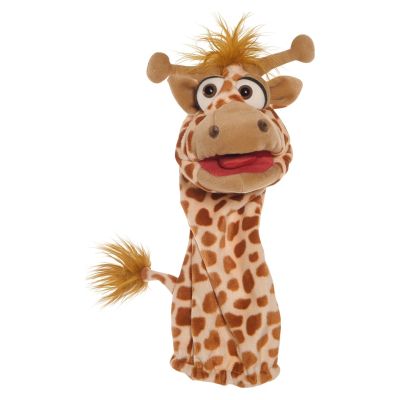
For “Tongue gym”, you need a hand puppet whose tongue can be worked as well. Many of the Living Puppets sock puppets from the Quasselwürmer range have one.
Sock hand puppets →Child characters as playmates
A child character soon becomes a playmate for the group, one who sometimes gets things wrong. In “Rhyme jumps” it thinks two words rhyme when they don’t, in “Syllable hops” it gets the count wrong, and the children help it out.
People 45 cm →Finger puppets for the whole group
In “Guess the animal”, every child gets an animal finger puppet. The hand puppet describes one of the animals in the circle, and whoever is wearing that animal makes it answer, then acts the animal out. Simple, affordable characters are all you need, for example from The Puppet Company. The hand puppet stays in charge.
Finger puppets →Puppet Company →For nurseries, groups and therapy sessions
The games work well for circle time, movement breaks at nursery and small groups in language support. Many of them also suit one-to-one sessions in speech and language therapy practices. It’s worth playing a game more than once: next time it goes more smoothly, and more children join in.
Advice and paying by invoice
We are happy to help you choose the right character for your group or practice by phone or through our contact form. Nurseries, schools, medical and therapy practices and care homes can also pay by invoice; we activate this option once we have checked your customer account.
Hand puppets with a movable tongue
These Living Puppets characters have a movable tongue as well as a movable mouth.




Explore more
Characters for language games in groups and practices.